Personal Data Lake
A personal data lake and knowledge graph on Google Cloud, provisioned end-to-end in Terraform and deployed from GitHub Actions on every push.
Terraform · BigQuery · Cloud Run · dlt · GraphRAG · Workload Identity Federation · GitHub Actions
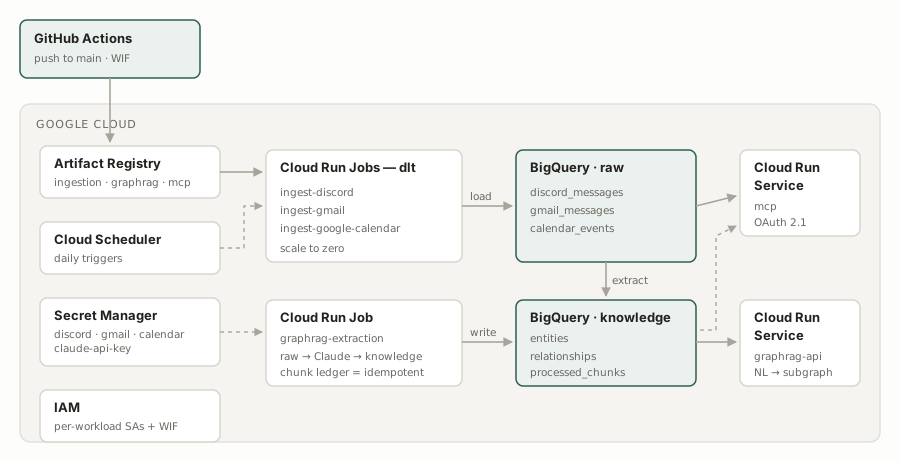
main → Actions authenticates with Workload Identity Federation → images to Artifact Registry → terraform apply → Cloud Run. Scheduler triggers ingestion daily; nothing runs between jobs.The problem
Three services that don’t talk to each other, and none of them answer the question I actually have: what have I committed to, and to whom? I wanted one queryable layer that resolves the same person across a Discord handle, an email address and a calendar invite — and knows a message from an open commitment.
The harder constraint was operational. It had to cost near-zero at idle and rebuild from an empty GCP project, or it wasn’t finished.
Scope
| Infrastructure | 11 Terraform files: BigQuery, Cloud Run services and jobs, Artifact Registry, IAM, Secret Manager, Cloud Scheduler, GCS state backend |
| Data | 3 sources → BigQuery raw → knowledge (entities, relationships, processed chunks) |
| Serving | GraphRAG query API and an MCP server with OAuth 2.1, both on Cloud Run |
| Deploy | GitHub Actions via Workload Identity Federation — no long-lived key exists |
| Ops | Cloud Scheduler daily; everything scales to zero between runs |
Three decisions
dlt instead of Airbyte. Airbyte is the obvious choice and wants always-on compute. This pipeline is idle 23 hours a day, so dlt runs the same extract-and-load as Cloud Run Jobs that scale to zero. Traded a managed UI for a near-zero idle bill — right at three sources, wrong at thirty.
Workload Identity Federation instead of a service-account key. The quick path leaves a permanent credential to my GCP project sitting in GitHub. WIF exchanges GitHub’s OIDC token for a short-lived one, scoped to this repo. Cost an afternoon of IAM debugging; there’s now no key to leak or rotate.
Twelve MCP tools down to five. One tool per access pattern reads as thorough and is worse: every definition is permanent context cost, and a large flat menu makes the model choose badly between near-identical options. Collapsing to five with a routing argument improved tool selection. Tool count is interface design, not a feature count.
What broke
Connecting the MCP server to Claude’s hosted client took six commits over two days — two faults stacked. The RFC 9728 metadata advertised the wrong resource URL, so OAuth completed and the client walked away. And FastMCP was rejecting the backend’s Accept header, which surfaced as a generic connection failure that looked identical to the auth problem. I fixed the metadata first, saw no change, and assumed the fix was wrong. Now I read the transport layer before the application layer.
Separately: the audit job kept dying until I found Cloud Run gen2’s 512Mi floor and the job sized below it.
Verification
terraform plan reporting no changes against live infrastructure is the check that matters — it’s what makes “the repo is the system” true rather than aspirational. A smoke script exercises the deployed MCP server over HTTP, and the extraction job keeps a processed-chunk ledger so re-runs are idempotent.
Constraints
- Single-user by construction. Identity is one configured person; no tenancy model.
- Extraction costs real money, so jobs ship with conservative chunk caps.
- Entity resolution auto-merges only on strong signals. Everything weaker becomes a candidate a human confirms — precision over recall, deliberately.
Next
- Move the raw → knowledge transformation into dbt. It grew inside the extraction job; dbt is its right home and would bring tests and lineage.
- A backfill mode separate from the daily incremental path.